The term 'ISO consultant' is used in various ways across the UAE market, and businesses approaching certification for the first time often aren't entirely sure what they're actually paying for whenever they engage a consultant. Knowing the specifics of the role can help set realistic expectations and makes it simpler to determine if a consultant is providing genuine value.Translating the ISO Standard into practical Business Terms
ISO standards are written in fairly formal, generalised language that is designed for use in a range of fields, meaning a significant part of a consultant's job involves translating those requirements into what they mean for the day-to-day operations. A skilled consultant spends time understanding how a company actually operates before suggesting ways its current processes can be mapped to the standards' requirements.
In conducting the Initial Gap Assessment
Most engagements begin with an organized gap assessment. This involves comparing current practices with the applicable standards to discover how things are currently operating, what has to be modified, and the ones that are missing entirely. The assessment determines the overall timeline for implementation and budget, which is the reason a thorough and honest gap analysis is essential more than an optimistic one that overstates the work involved.
Helping to build or refine Management System Documentation
If gaps are found, consultants are usually able to help create or modify the written procedures, policies and documents required to show compliance, although modern standards place a premium on genuine process adherence over paperwork volume. The best consultants are those who fight against excessive documentation for the sake of documentation while recommending a system a enterprise actually will use over one created solely to meet the auditor's guidelines.
The Training Staff is trained on new or modified processes
Implementation shouldn't be just a management exercise, as employees at every level typically need to understand the trends in their daily work routines and why. Consultants frequently run training sessions to develop this understanding, since a management system that's only on paper, without genuine staff acceptance can quickly unravel once the initial certification pressure has been surpassed.
Conducting Internal Audits - Before the Actual Thing
Many standards require at-least one internal audit before an external certification audit takes place, and consultants often either do this themselves or train internal staff to do so. This internal audit acts as a genuine dry run, to identify issues before there's time to address them rather than discovering problems for the first time before an auditor external to the company.
In support of the business through the External Audit
While consultants generally can't be present acting on the business's behalf in your certifications audit because of the independence requirements Good consultants plan businesses for the audit thoroughly and are in a position to assist with interpretation and rectify any violations the external auditor identifies.
What a Consultant Shouldn't Be Doing
A reputable consultant should never be the same company providing the certificate because this arrangement compromises any independence that the entire system depends upon. Any consultant who offers to implement your system of management and then certify it under the one roof is a warning sign that you should take seriously rather than being a shortcut.
Assistance in Interpreting Standard Updates and Revisions
ISO standards are often revised The best consultant informs clients of future changes long before they become mandatory, giving companies time to adjust rather than scrambling at the last minute. The ongoing advisory role usually continues long after the initial certification phase especially for companies that retain a consultant on a periodic basis for support for surveillance audits.
Modifying the Approach to Business Size
A reputable consultant will scale their approach in a way that is appropriate to the situation, whether it's a one-person startup or an entire enterprise, because a management system that's proportionate to business size and complexity is greater likelihood of being managed with ease than one based on more extensive requirements of an organization. Be wary of a one-size-fits all template which is used regardless of the organization's size.
The Building of Internal Capability. Not Dependency
The most skilled consultants try to make a client more self-sufficient as they found it. developing internal employees to eventually manage much of the system without causing an ongoing dependency purely for the sake of their own continuous billing. Inquiring directly with a prospective consultant about their approach to internal capability building is a great way to gauge whether they're dedicated to long-term customer satisfaction.
An attainable timeframe for engaging the Services of a Consultant
Companies often don't realize how early in the certification journey the consultant needs to be hired, sometimes seeking out consultants only when the deadline for engagement is imminent. Engaging an expert early enough to conduct a true gap assessment, rather than rush implementation under the pressure of time creates a more solid and more durable management system as opposed to a rush, deadline-driven engagement.
Recognizing the requirements for a consultant
Certain UAE businesses, particularly larger ones that have dedicated compliance or quality personnel eventually reach a level where they can handle ongoing control audits and routine changes largely within the company, requiring a consultant only for occasional professional input. Recognizing this change instead of having to provide full consultant support for a long time, is a sign of a maturing management system that has become a core part of how businesses function.
Understood properly, a good ISO Consultant in the UAE performs more than just a supplier of paper documents and acts more of an adjunct to the management team, helping guide the business through an operational change rather than making documents to satisfy an external demand. Selecting the right consultant in addition to knowing exactly what their role ought to and shouldn't include, makes the difference between a certification project which truly enhances the way in which a business is run and which issues a certificate that doesn't have any lasting operational change behind it. This does not make the work of a consultant any less important, but it is a reminder to businesses to approach the relationship as a genuine partnership, rather than outsourcing the entire certification burden to another person. A change in mindset alone can help towards a satisfying and lasting result for certification. When approached this way, the engagement is now a genuine investment instead of merely a costs for compliance. This is a distinction worthy of paying attention to throughout. Follow the recommended ISO 27001 Certification for more info.

ISO 14001 Certification A Reason To Use Iso 14001 Certification Environmental Management Is Important For Uae Companies
Environmental issues have shifted from as a mere concern to being an essential aspect of business across the UAE with the help of nation-wide sustainability goals and by rising client and regulatory expectations. ISO 14001, the international standard for environmental management systems, has become the natural answer when companies want to demonstrate the real, systematic commitment to sustainability in addition to good desires alone.What ISO 14001 Actually Requires
The standard requires businesses to analyze the environmental impact of their operation, be aware of the effects these aspects can have and implement systems in place to control the negative impact in the course of time. This might mean anything from managing waste and emissions in a factory setting to cutting down on paper and energy usage in a service-oriented office business, since it is proportional to what the actual environmental footprint appears to be.
Alignment with UAE's National Sustainability Goals
The UAE's national commitments concerning sustainability and net-zero goals have triggered a genuine momentum in the field of environmental management. ISO 14001 certification gives individual enterprises a recognized method for them to show that they're in alignment with the wider goals. This alignment increasingly matters for companies who bid for government and semi-government contracts. Environmental certifications are becoming a more explicit evaluation criterion.
Industries That Matter Most
Construction, manufacturing, oil and gas, and logistics face the most direct environmental scrutiny, due to the physical scale of their operations. However, service-based companies are increasingly looking to obtain certification as well, both to be eligible for tenders and also costs savings resulting from the use of resources more efficiently. Even those with a light environmental footprint often find the systematic approach uncovers surprising efficiency opportunities.
Legal Compliance Angle Legal Compliance Angle
A substantial portion to ISO 14001 involves identifying and making sure that compliance is tracked to relevant environmental legislation and regulatory requirements. This in the UAE in the context of environmental legislation spans federal legislation as well as regulations specific to the emirates. Certified companies typically possess a better, more accurate picture of their governing obligations than non-certified competitors, reducing the risk of accidental non-compliance, and consequent penalties.
Integration With Other Management Systems
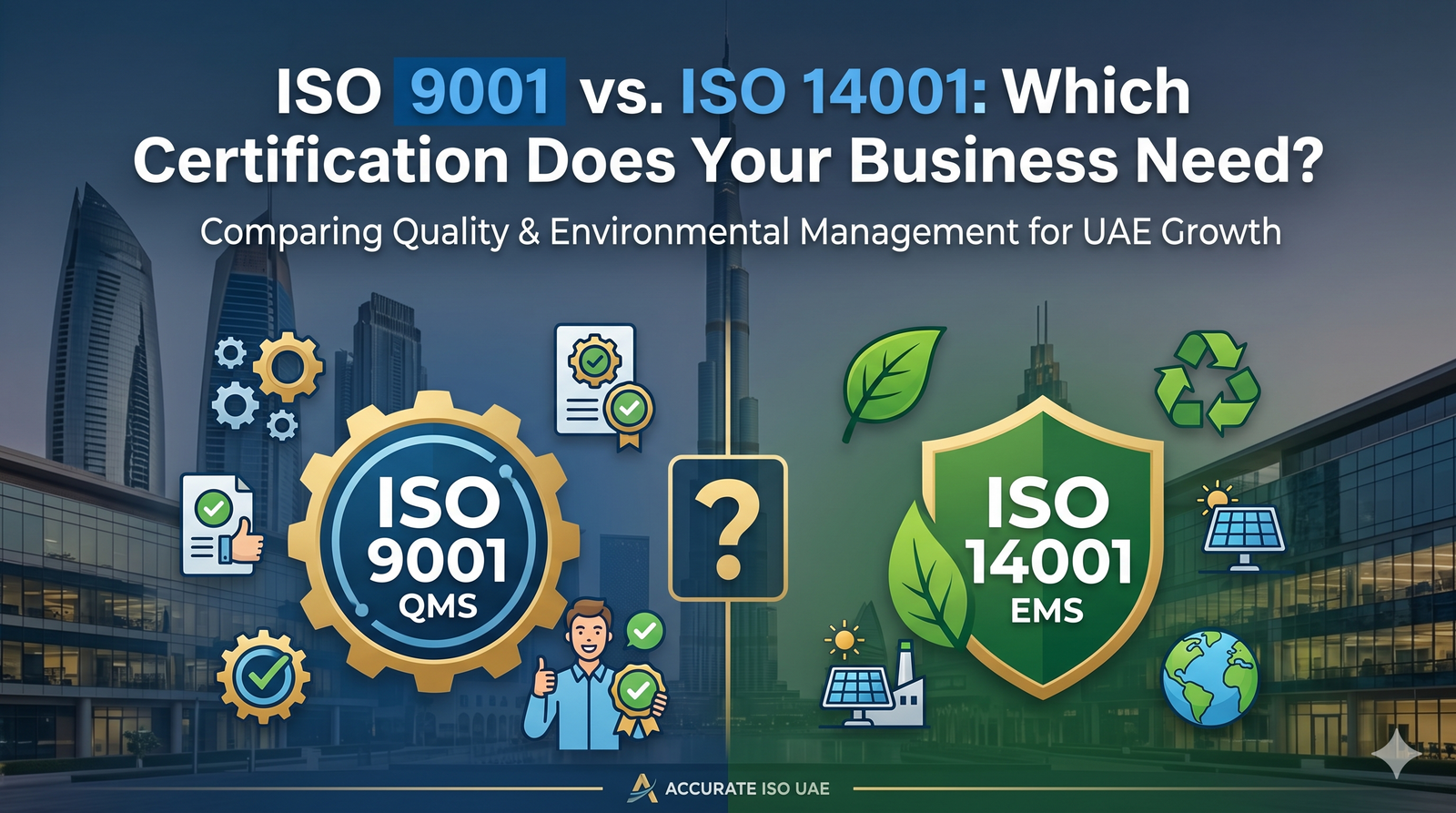
Many UAE businesses that are seeking ISO 14001 already hold or are currently pursuing ISO 9001, and the two standards share the same structural features that an integrated management program that covers both can be more efficient when compared to treating them like separate projects. This method of integration reduces duplicated the documentation and auditing process significantly to companies managing multiple certifications.
What is the Certification Process looks like
As with other management systems standards certification follows a standardized course: a initial gap analysis, the implementation of required processes and documentation, external audit, and after that, an external audit performed by an accredited certification body. Continuous surveillance audits, which are typically each year, check that the environmental management system has been properly maintained instead of reversing the process after the initial certificate has been issued.
Truly Business Benefits That Go Beyond the Certificate
Beyond eligibility for tenders and regulatory transparency, companies that have implemented ISO 14001 properly often uncover significant cost savings due to an improved resource and waste management, alongside reputational benefits for environmentally conscious customers and partners. These benefits in practical terms are a part of the reason why environmental certification has taken on a new meaning that goes beyond just a compliance-driven requirement for many UAE companies.
Measuring What Actually Matters
A properly implemented ISO 14001 system focuses measurement efforts on environmental factors that matter in a specific industry instead of tracking metrics purely because they're easy to measure. Logistics companies may prioritize transportation efficiency and fuel consumption when compared to a manufacturing facility that may focus more on water and waste generation which reflects where each company's actual environmental impact will be.
Engagement with Suppliers and Contractors
Many UAE firms have found that a significant portion of their overall environmental impact is attributable to contractors and suppliers rather than directly with their own activities. ISO 14001 encourages businesses to take into consideration this wider effect of supply chains, instead of looking at environmental management as solely an internal issue. This has prompted some ISO 14001 certified UAE enterprises to begin asking their suppliers directly about their environmental practices, resulting in some kind of ripple effect that is spreading through suppliers in the supply chains local to them.
Security Preparedness for Emergencies is Part of the Standard
ISO 14001 requires businesses to detect potential environmental emergencies relevant to their work, for example, chemical spills or equipment failures that can have environmental consequences as well as have real-time strategies for response instead of handling circumstances reactively. This 'preparedness' element frequently reveals holes that businesses had not previously thought of, especially in relation to staff instruction for situations of emergency.
A Standard that Rewards True Engagement
In the end, ISO 14001 rewards businesses who consider environmental management an operational and continuous priority rather than a documentation exercise which is only completed once and forgotten. UAE companies that embed the ISO 14001 principles into their daily decision-making rather than separating it within a separate compliance function, will reap the most positive environmental and reputational advantages as time passes.
Water Management Needs Special Attention in the UAE Context
Because of the harsh climate of the Middle East and reliance on desalinated water, water use and management often require special attention within the ISO 14001 system compared with areas where water scarcity is not as significant. Businesses that incorporate water efficiency into their management of environmental issues in the beginning will find this among the most practical benefits of certification in the local setting.
For UAE businesses weighing up ISO 14001, the certification offers both a reaction to real market and regulatory pressure and an opportunity to control environmental impacts in a more systematic manner, which influences regulators and clients and the UAE's ambitions for sustainability across the country. As environmental expectations in the UAE continue to increase, businesses that build genuine sustainability capabilities now, instead of waiting until it becomes an inevitable requirement, will find themselves considerably better positioned in the future. This should not cause anxiety for small companies in the sense that the standards scales appropriately, and even modest true environmental enhancements implemented consistently can satisfy auditors far more than a lofty plan but never actually carried through. Consistency, rather than the mere pursuit of ambition, is the only thing that auditors and real green outcomes can be rewarded with. Small, sustained changes tend over ambitious goals that are stalled after a few months. See the top ISO Certification Company UAE for blog info.